Parish/Church
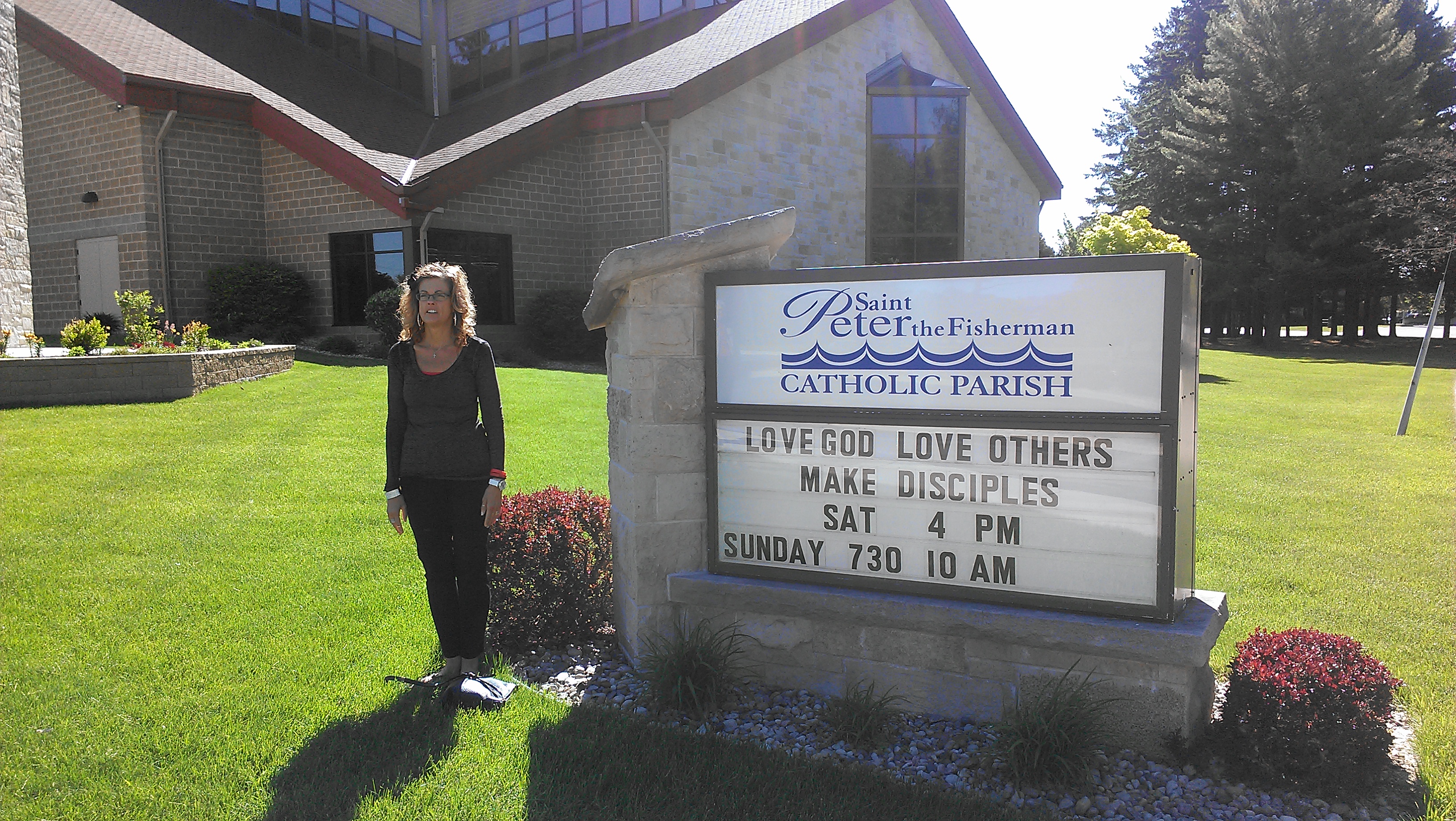
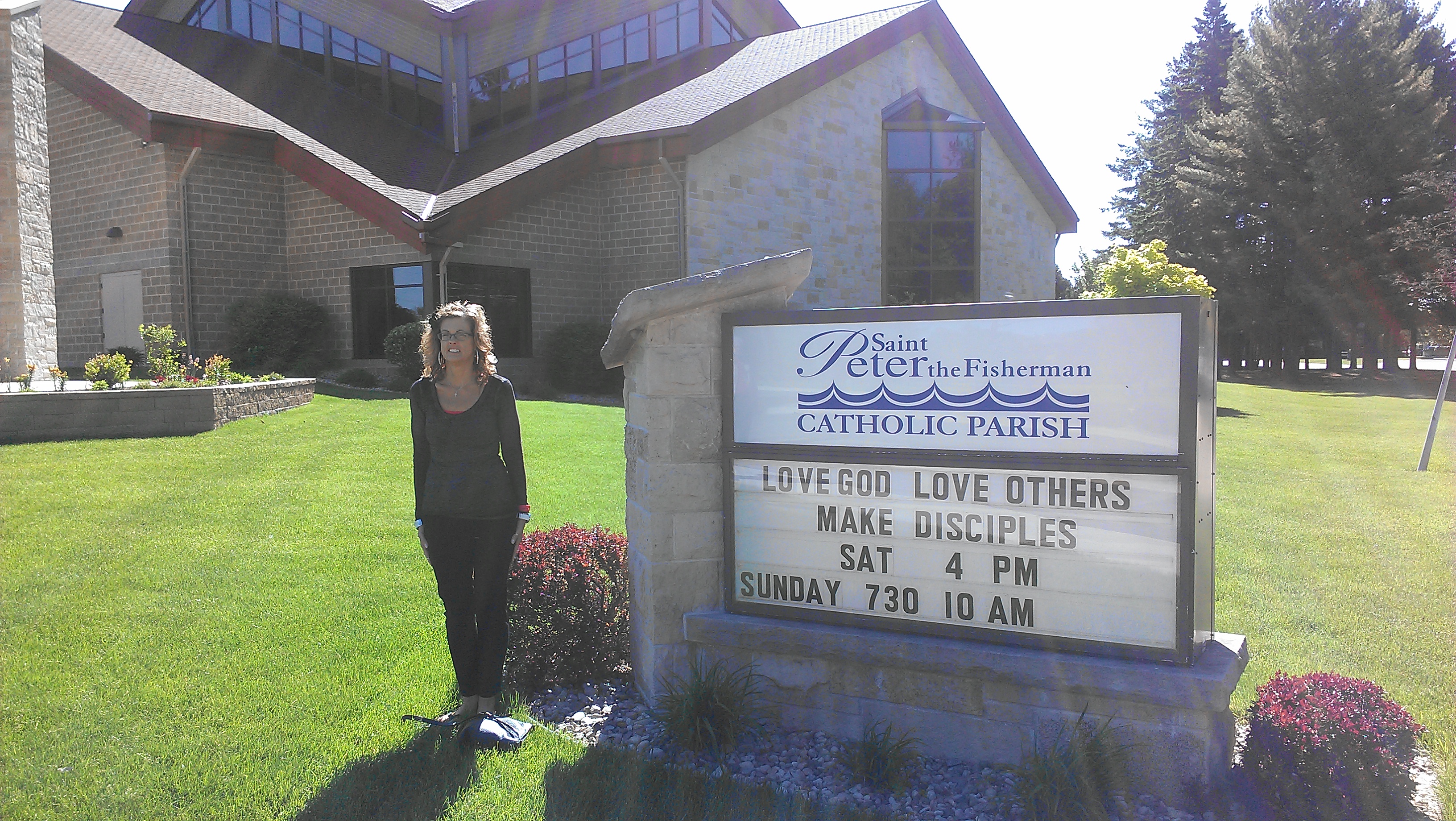
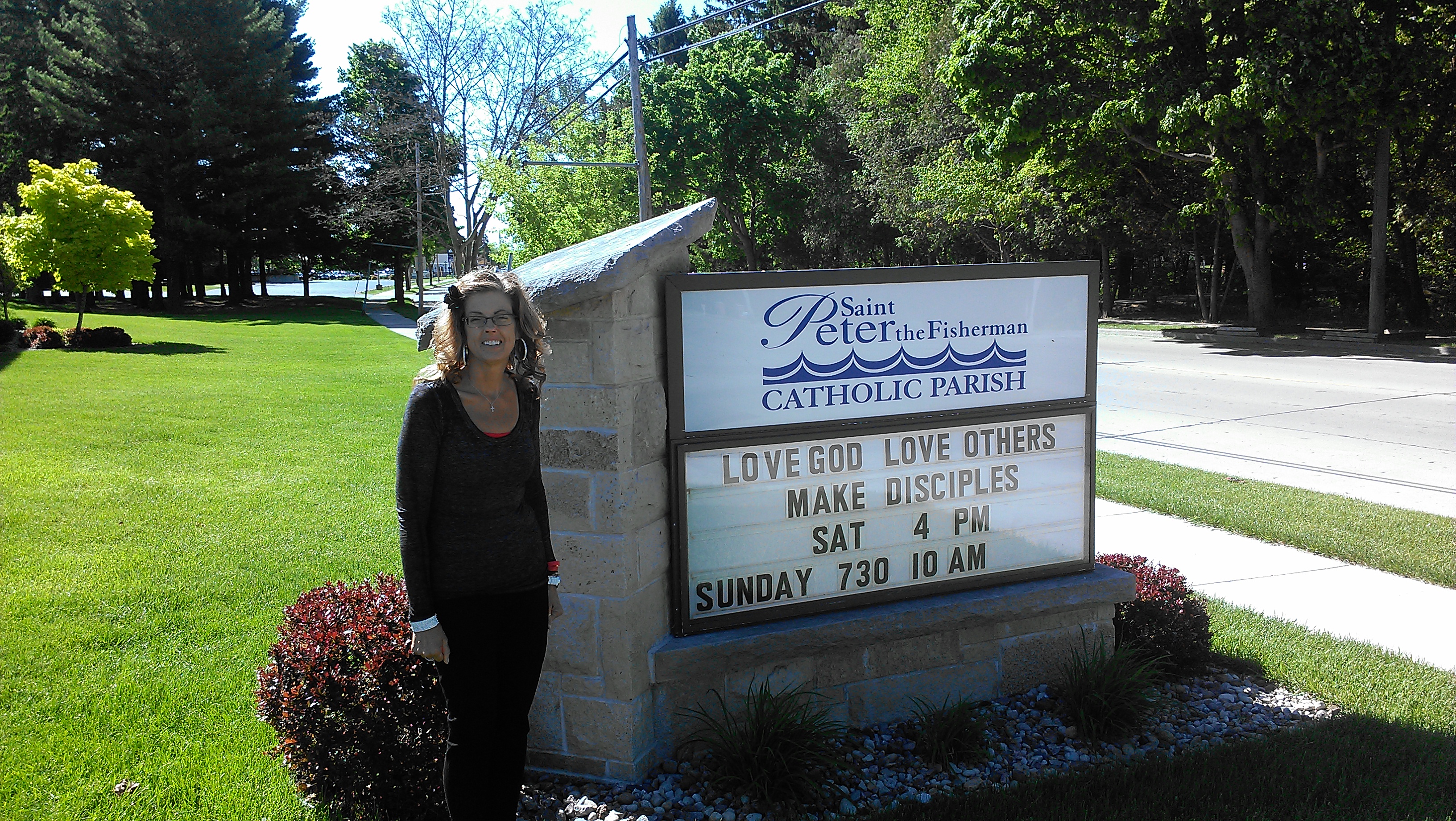
St. Peter the Fisherman - Two Rivers, WI
Date and Mass time
June 8, 2014 – 10:00 am Mass
Celebrant
Fr. Tom Reynebeau – Pastor
Fr. Peter Mitchell – Assistant Pastor
Weather
BE-A-U-TI-FUL!!! It was sunny and probably 75 when we left Denmark at 9am but cool and maybe 65 when we arrived in Two Rivers. The east wind was definitely cooling things off from the lake. After Mass it was still cool but the wind had shifted to the north and it was a perfect 70 degrees or so.
The trip there and back
We left Denmark at 9am and picked up Kay’s mom Joanne who made the trip with us. It was a gorgeous day and we made it to St. Peter the Fisherman parish by 9:30am. On the way home we headed south to Manitowoc and made quite a few stops. First we headed to Perkins for breakfast (even though it was nearly noon). We all had a standard breakfast and was very good. Then we stopped at Menards for a dehumidifier, at the Dollar Store for some stuff, and then finally Rob’s for some groceries. We were home by 2:30pm after a great day!
Reflections
Our second stop on our pilgrimage is St. Peter the Fisherman in Two Rivers. I picked this stop for two reasons; 1) It was close and I hoped that Kay would really like it and help reinforce what we were doing, and 2) Fr. Peter Mitchell is assistant Pastor there but will soon be re-assigned to St. Mary in Greenville. Fr. Peter was a speaker at our CEW in spring of 2014 and had left a real impression on me and I wanted to see him and again, I thought Kay would really like him and help reinforce what we were doing.
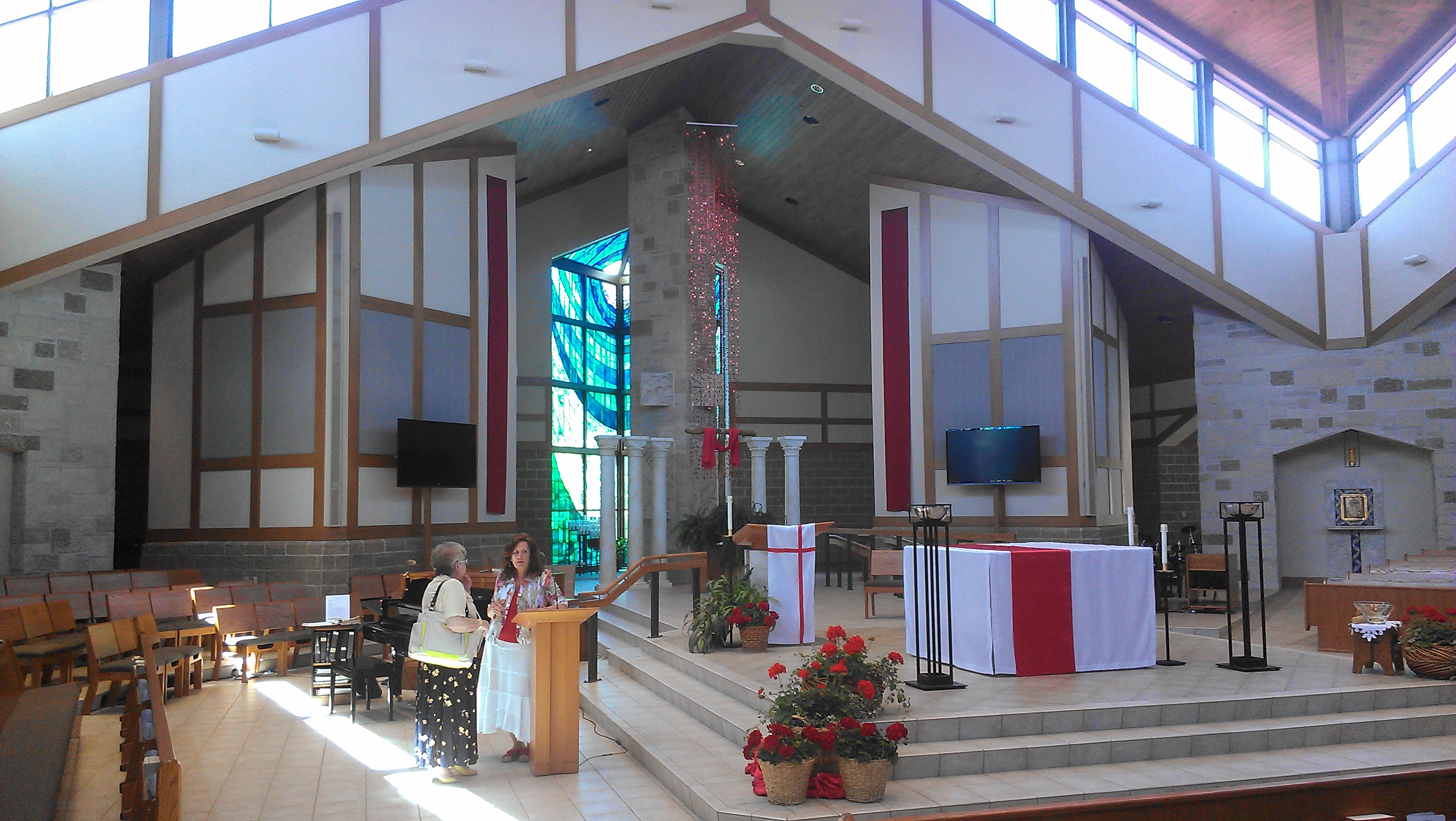
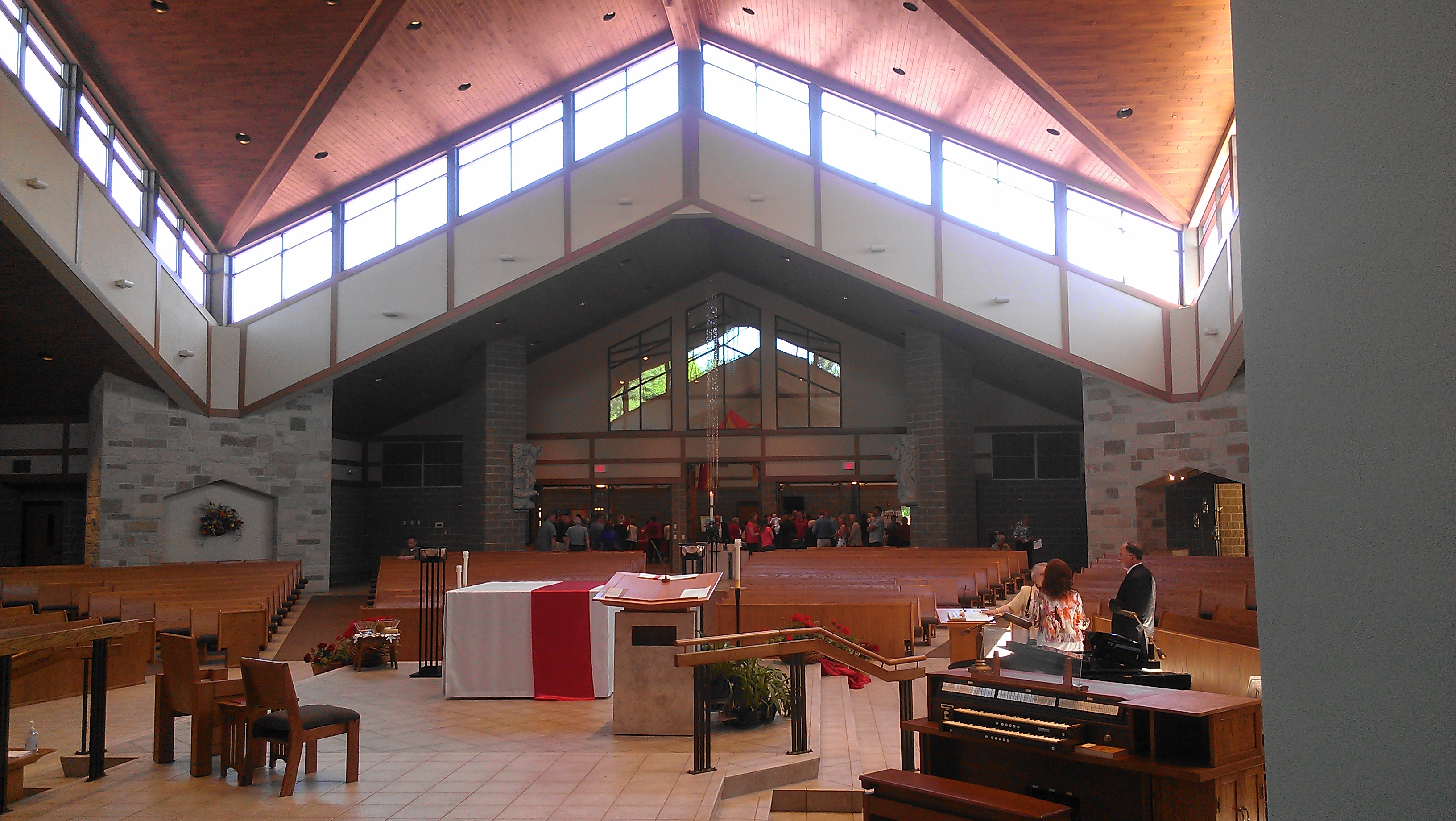
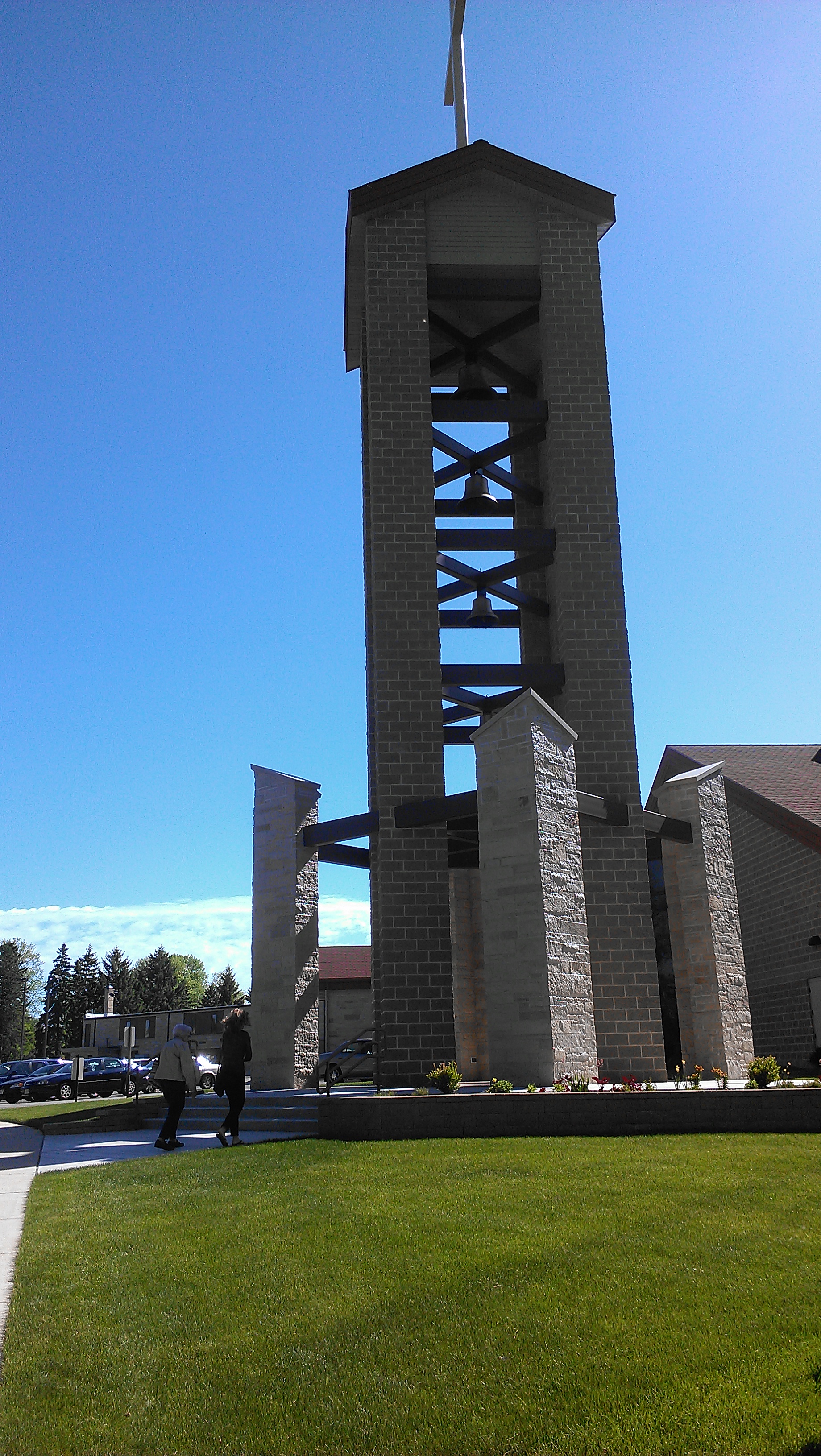
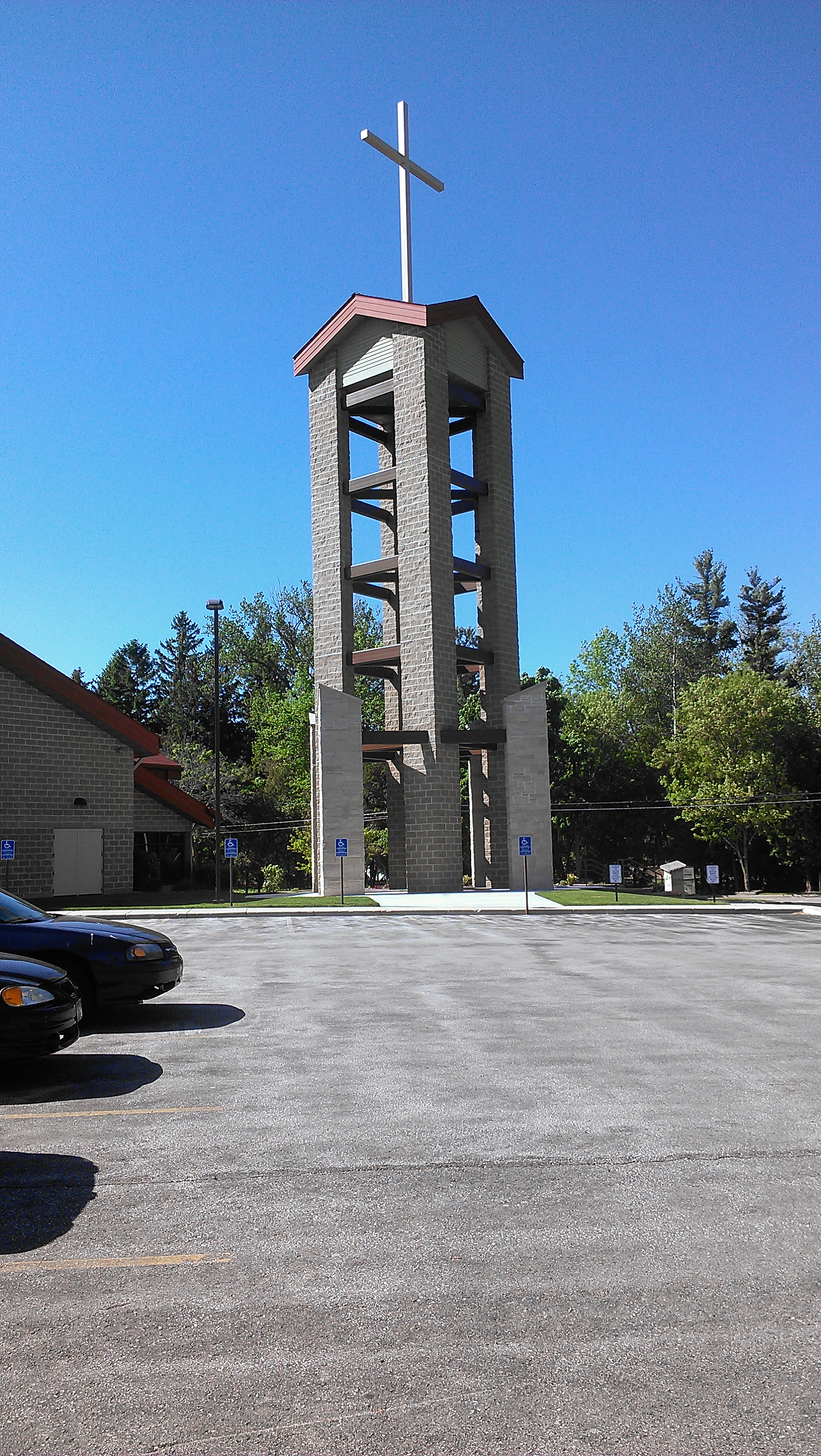
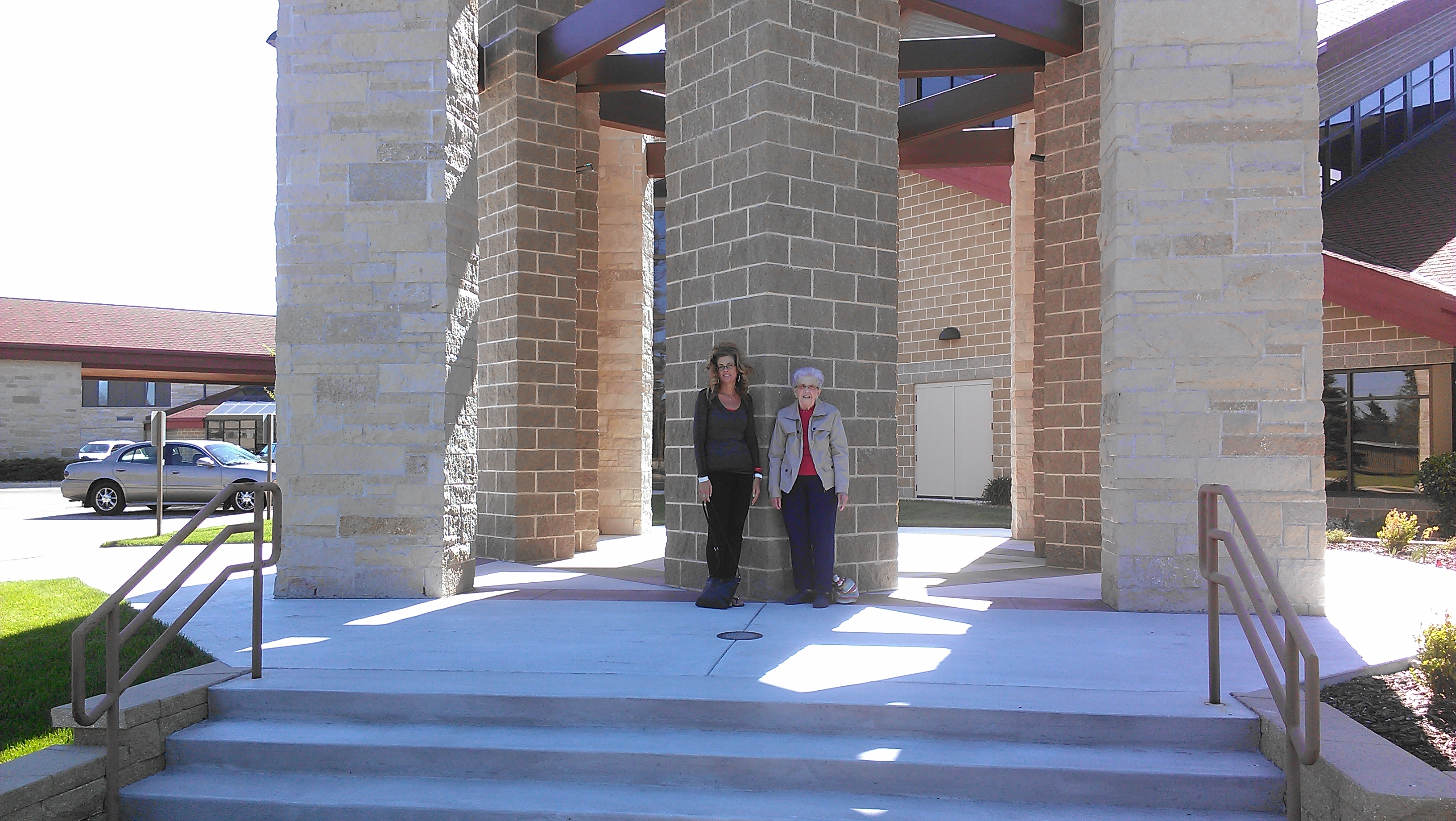
St. Peter the Fisherman is a pretty new church, at least as far as the building is concerned. (See the history section). The current building was dedicated in 2005 after the merger of the existing parishes in town. I am sure it was no small endeavor, but the results are great. The church was built in what I call the “new style” with a semi-circular design with the altar in the middle and rows of pews extending out from the alter amidst aisles that would look like wagon wheels spokes. It’s not huge but overall very nice.
Our first impression was that this was a friendly parish as we were early for Mass but greeted repeatedly by various parishioners with “hello”s, “good morning”s, and “how are you”s. this continued after Mass as well.
Fr. Tom presided at Mass with Fr. Peter assisting. I am not sure why they have two priests at the parish (I am sure they have a good reason and I am not second guessing anyone), but this may be the best combination of priests I have personally ever seen. They are both so energetic, personable and visibly Holy. They are a wonderful witness to Christ’s presence here on Earth.
Mass started with a blessing for two babies being baptized after Mass. The choir was pretty great but I don’t think the church is great acoustically (not that I have a great ear or anything) as I think in the right venue they would be incredible. Today we celebrated Pentecost and many were in red including the red vestments of our priests.
Obviously much of the Mass was centered on Pentecost but the highlight was a story of Pentecost that Fr. Tom read during the homily. I don’t recall the origins (sometimes I need to listen better) but it was based on the Gospel accounts of Pentecost but injected a lot more detail on the part of a “19 year old” witness. The witness and detail injected a LOT of power into the story and helped (me at least) realize what a huge moment this really was in the church. It was the birth of the church as we know it. Amazing!
Spiritually it was an above average Mass. Often when I visit other churches I am a little pre-occupied with my surroundings instead of focusing on the Mass, but this time I was better in tune. As I often am (and I can’t explain why but it feels right) I was moved to near tears during the consecration as well as on my way up the aisle to Communion.
After Communion Fr. Peter called up a group of youth to be blessed before their pilgrimage to Poland. Fr. Peter has orchestrated a youth trip, sponsored by donations from the parishioners, to Poland. They will be visiting Warsaw (Wawel Cathedral, burial place of St. Stanislaus and daily visits to the Shrine of Divine Mercy, the convent where St. Faustina Kowalska wrote her famous diary), Auschwitz (To pray at the cell of St. Maximilian Kolbe) Wadowice (Hometown of our newest Saint John Paul II.) and the Shrine of Our Lady of Czestochowa, the Black Madonna who is venerated as the Queen of Poland. Lastly on the trip they will be hiking in the High Tatras Mountains in Slovakia, where John Paul II loved to spend his vacations with his students.
Fr. Peter blessed the group of students and asked for prayers for them during their journey but also said that they would be taking the prayers of the parish with them. VERY inspiring stuff!!!
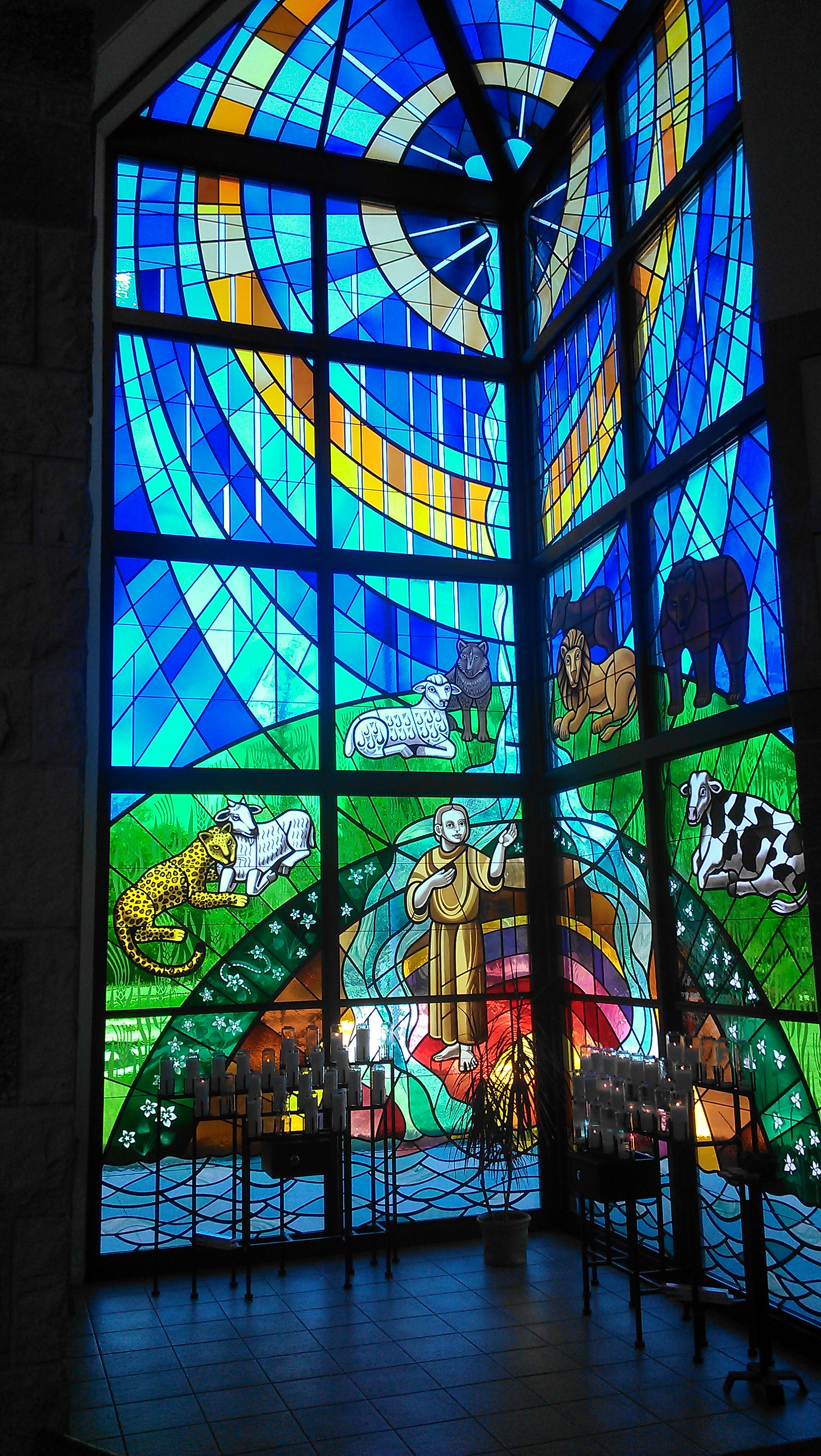
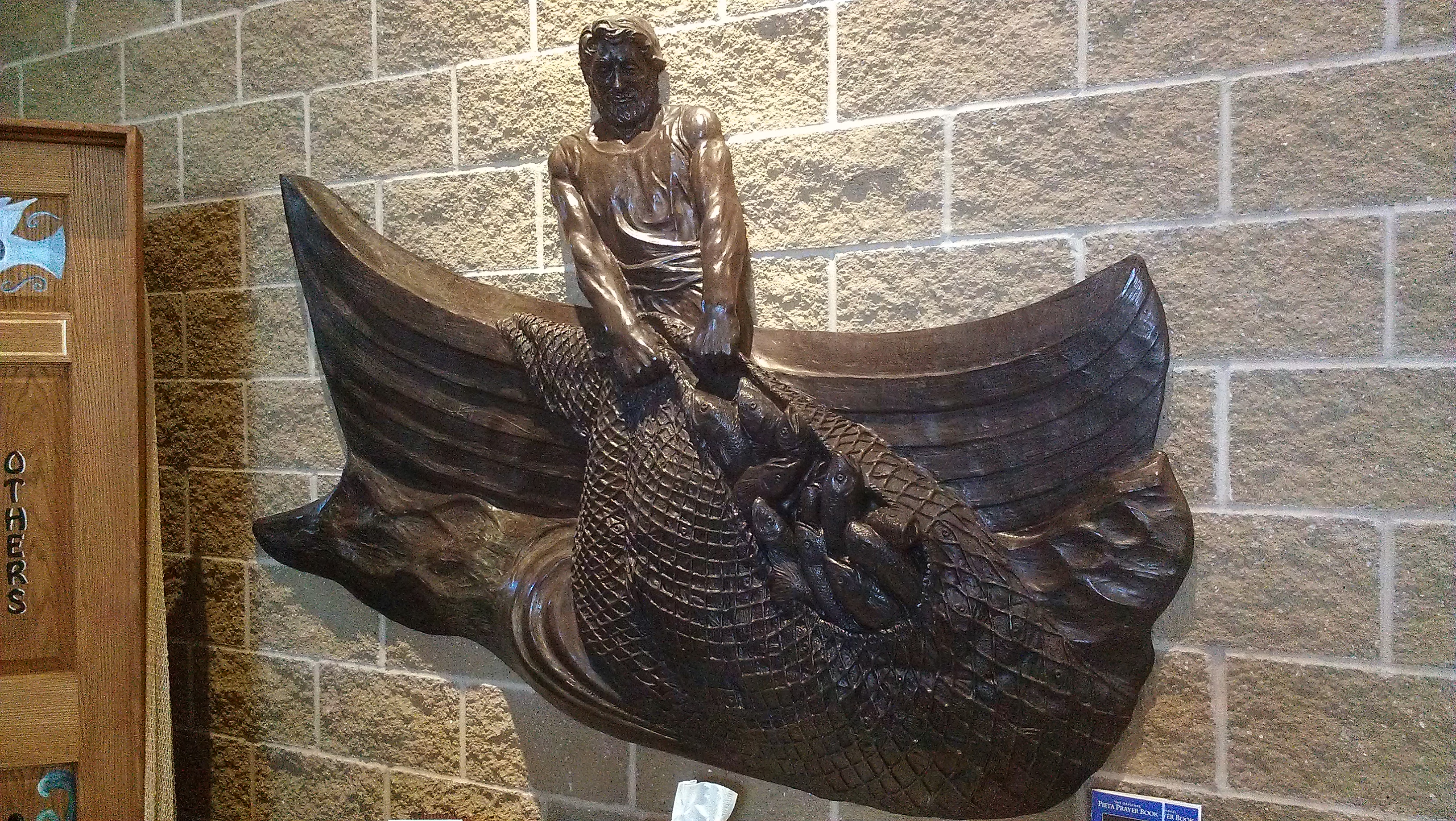
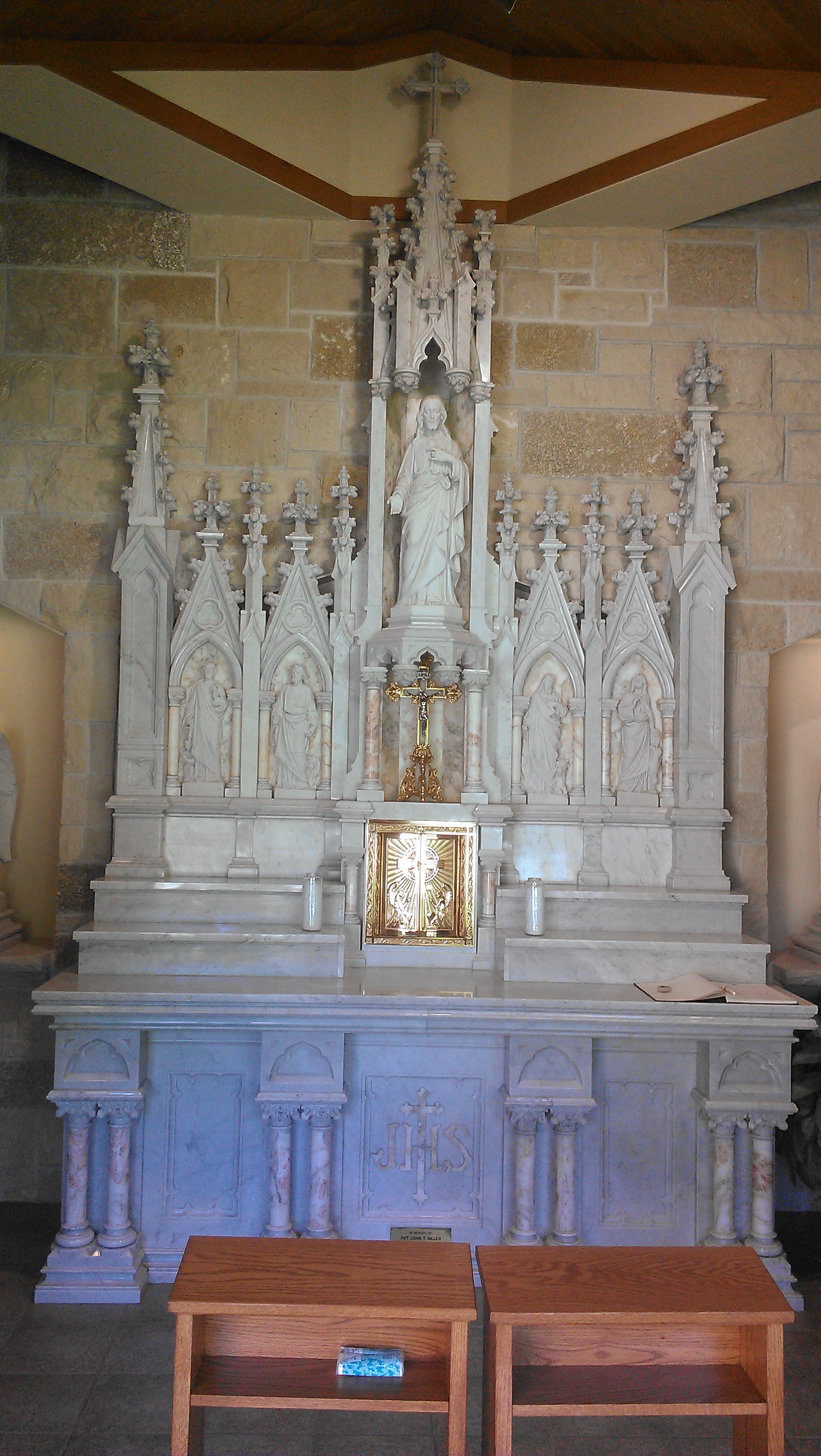
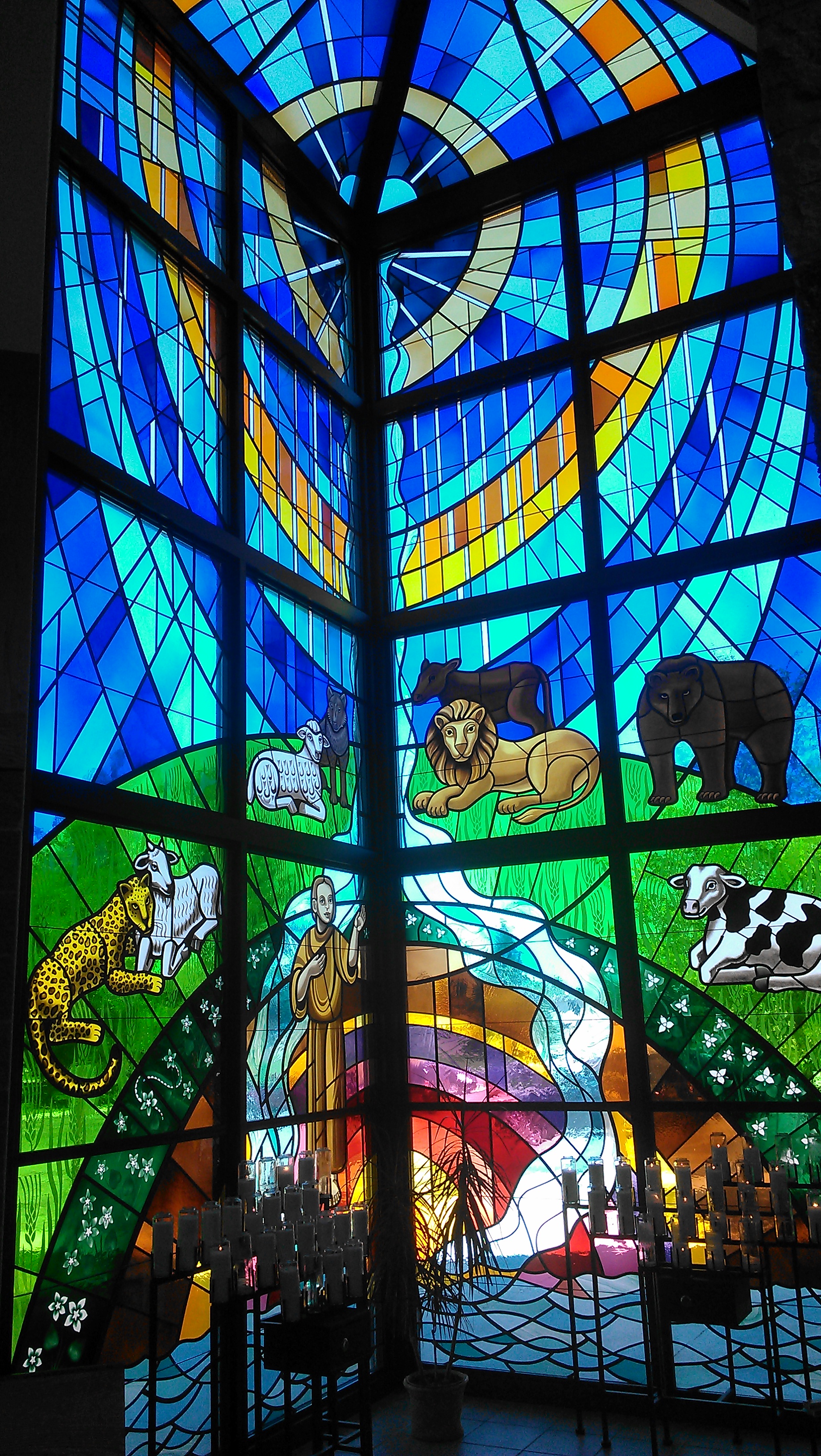
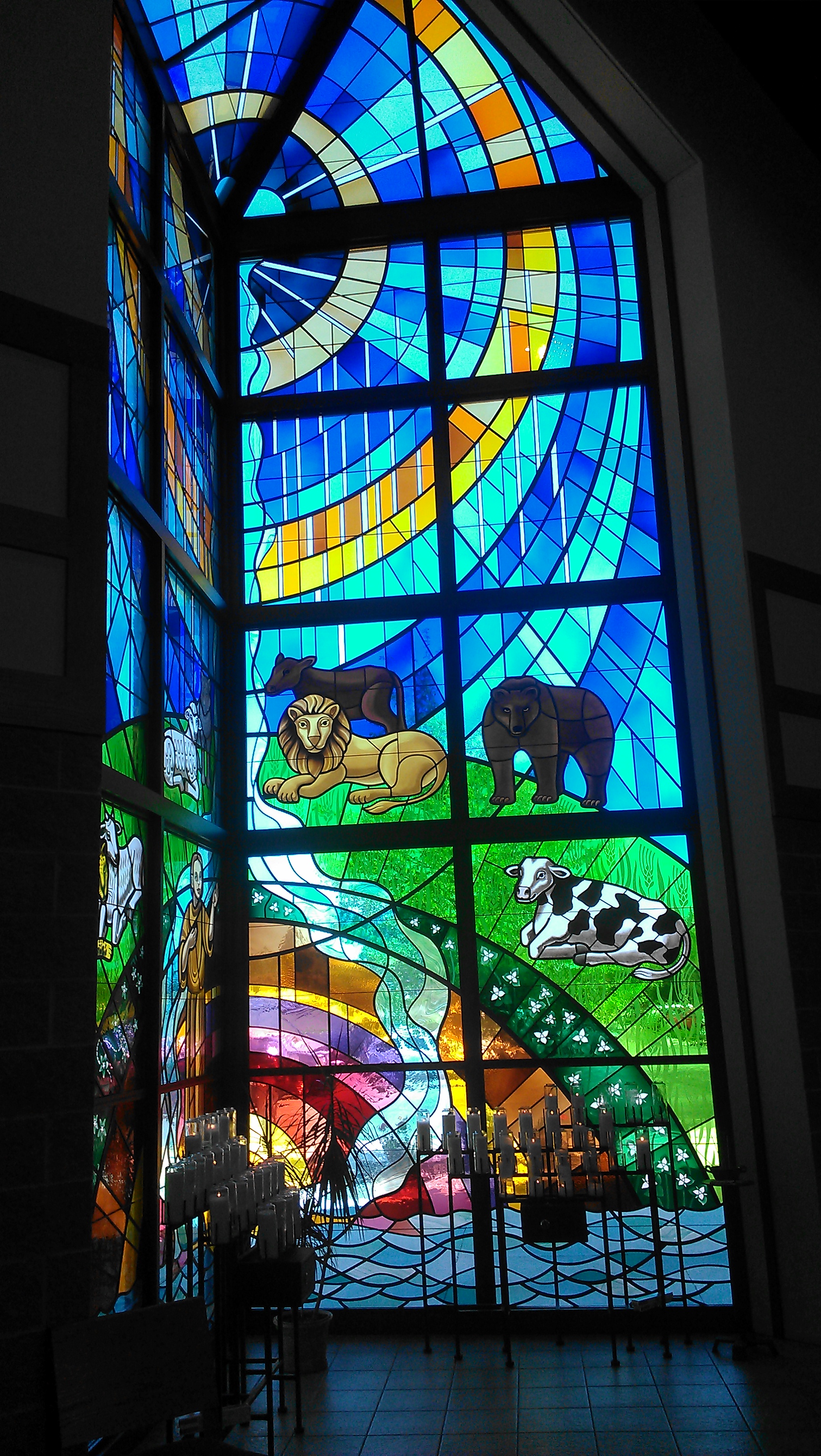
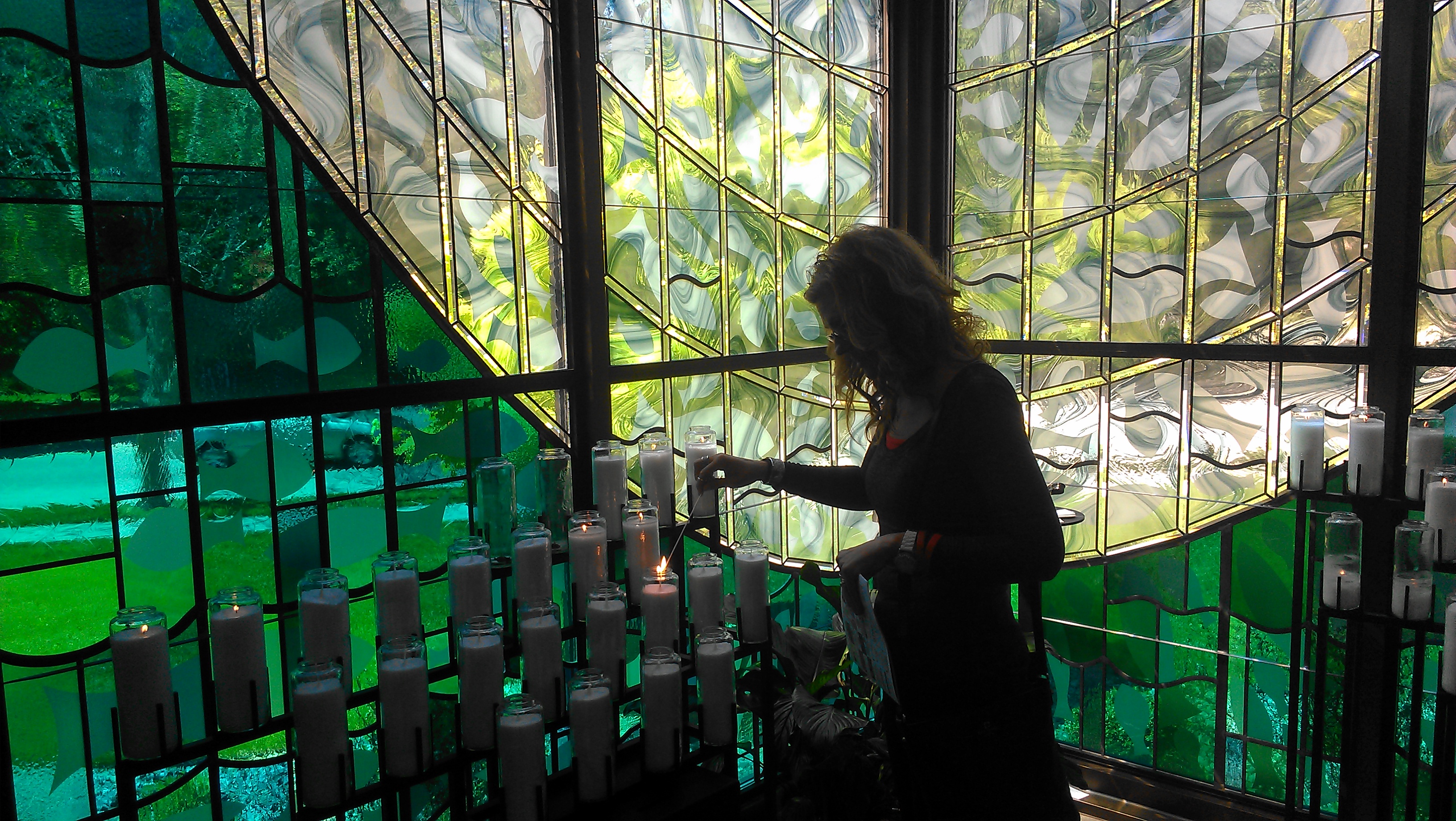
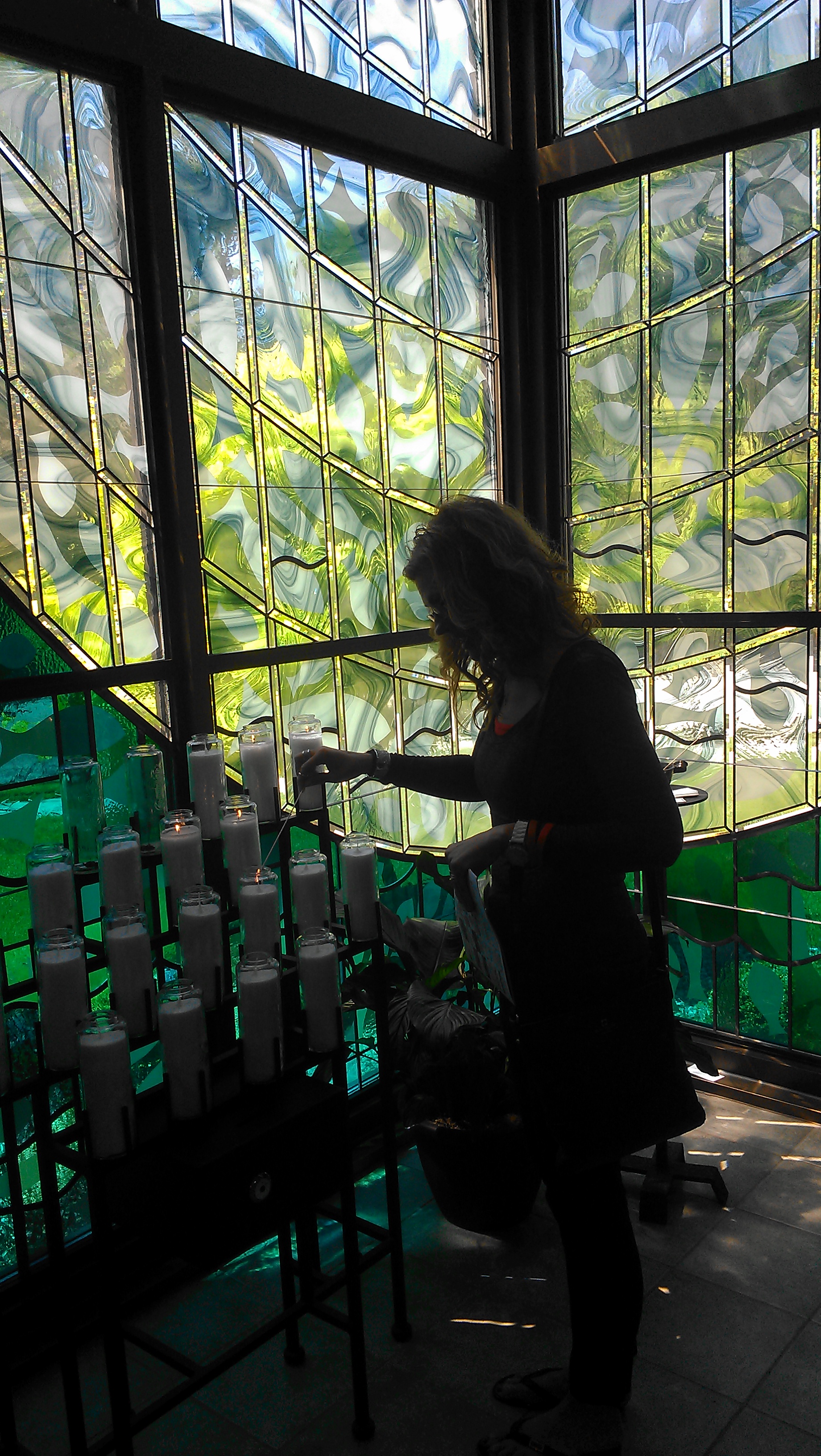
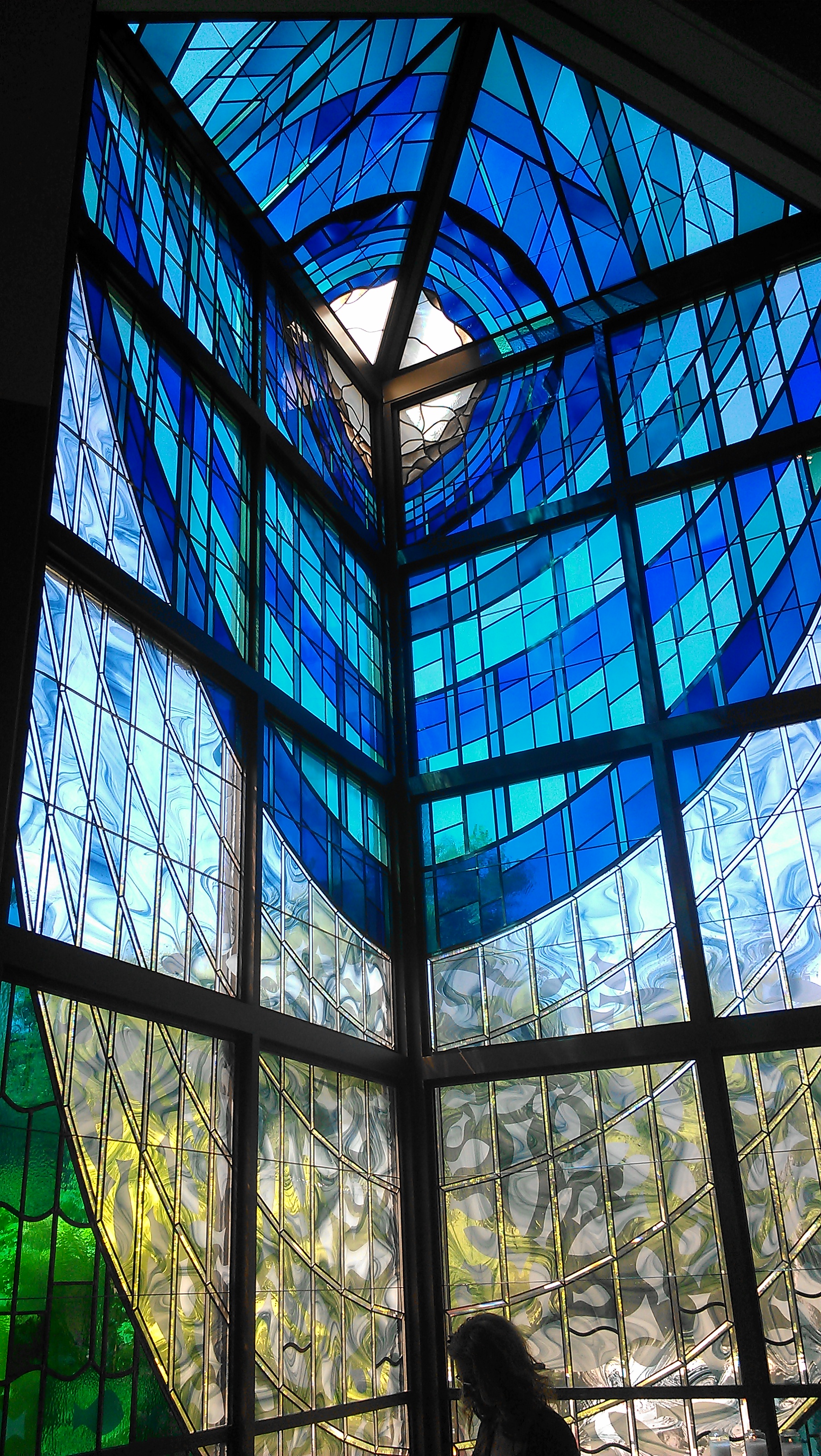
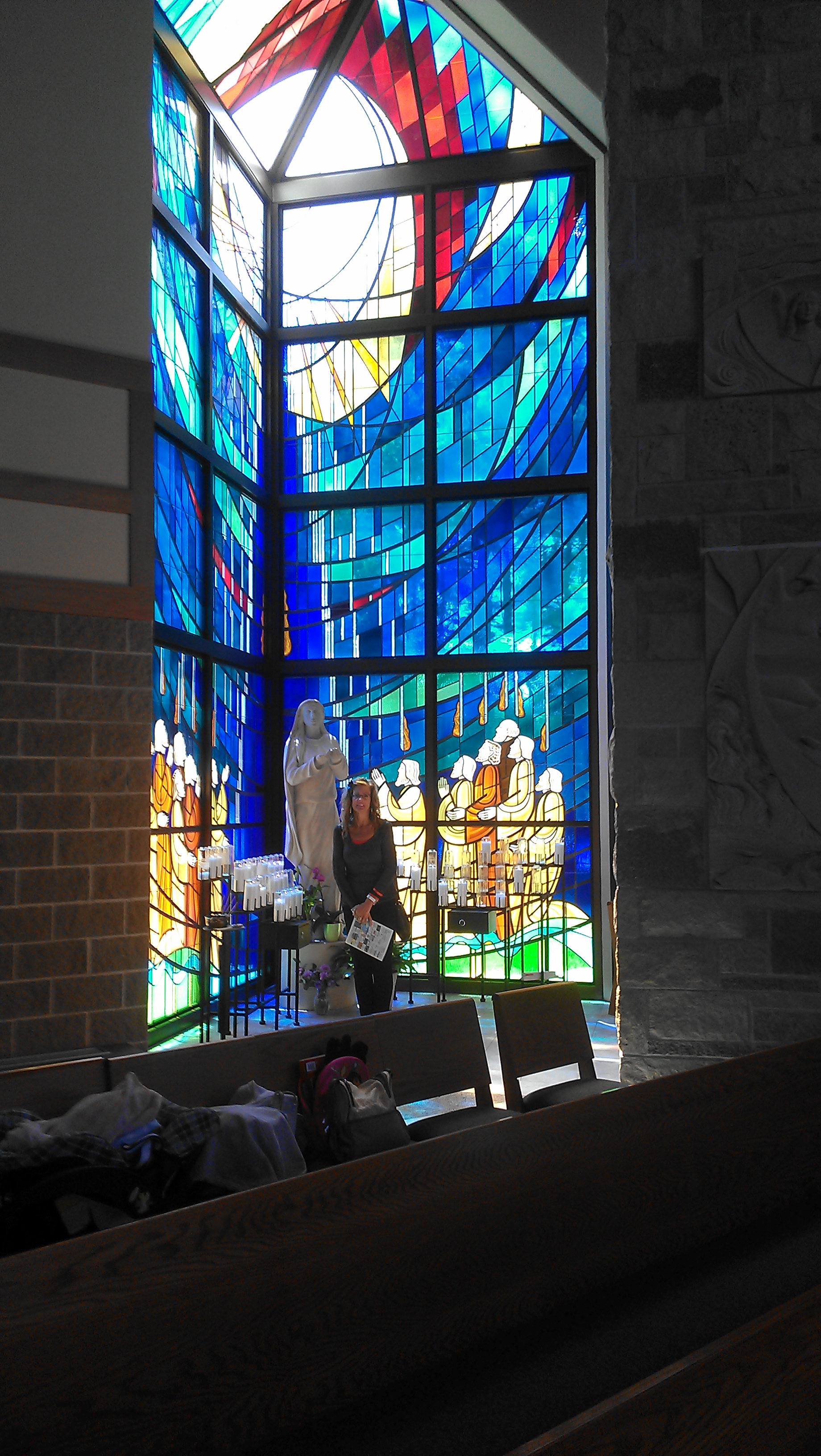
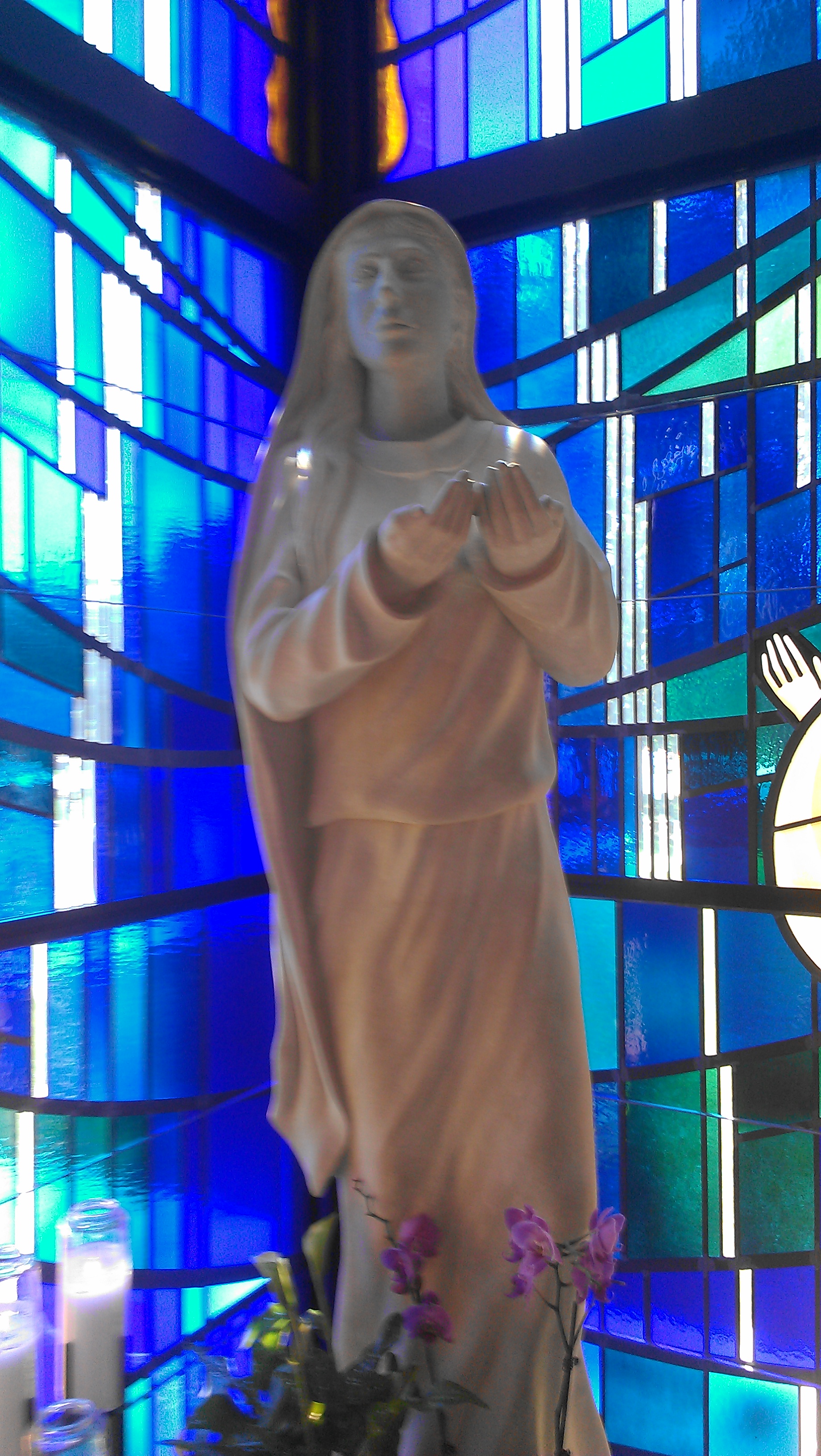
After Mass Kay and I toured the church and took pictures. After the fact I found that Kay loved the Stations of the Cross that kind of circled the inside of the outer walkway around the church. (I wish I would have taken pictures of them, but perhaps next Lent we will go there for Stations.)
After our tour we went out in the gathering area and met and thanked Fr. Tom and Fr. Peter. As I mentioned, both are very wonderful people and fine priests. We are very lucky to have them in our diocese!
This was only our second stop but what a GREAT one it was! We can’t wait for the rest! 150 to GO!
Parish History
From - http://www.spfcp.org/history.cfm
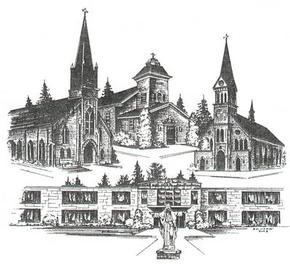
The churches that brought about St. Peter the Fisherman are depicted, above. From the top, left was Sacred Heart, St. Mark & St. Luke. The bottom Church was Most Holy Redeemer. Only St. Luke Church and Most Holy Redeemer stand.
St. Luke Church is next to City Hall and is used as a gymnastic training center, on Jefferson St.
Most Holy Redeemer is now Marion Hall or the Ministry Center; and the Religious Education classrooms are located on the second floor.
SAINT PETER THE FISHERMAN PARISH HISTORY
July 1, 2002, the plan for Saint Peter the Fisherman Parish was born, and with it, a single Catholic community in the city of Two Rivers was also born. Or was it? Actually, the birth of Saint Peter the Fisherman Parish marked a rebirth of a single Two Rivers Catholic community. The history of Catholicism in Two Rivers is the story of a people’s journey from unity to diversity and back to unity again.
I
The Two Rivers Catholic community dates almost to the origins of European settlement on Wisconsin’s lakeshore. Late in the summer of 1845 the first Mass in Two Rivers was celebrated by Rev. Casper Rehrl, one of Wisconsin’s great missionary priests (J. Schmitt, 35). A native of Austria, Fr. Rehrl was in the first months of his missionary career in the United States (Naber, 12). Fr. Rehrl, who preached in German, covered a missionary territory that included Sheboygan, Manitowoc, Brown and Fond du Lac Counties. It took him three months to traverse his route, visiting the numerous small settlements of Catholics scattered throughout the northeastern Wisconsin forest (J. Schmitt, 14;Naber, 3). Also ministering to Two Rivers Catholics in these earliest years was another missionary, Rev. A. Godfert, who preached in English and French (J. Schmitt, 14). The original Two Rivers Catholic community was clearly multi-ethnic, with numerous people from Southern Germany living south of the West Twin River, English speaking "Yankees" living between the rivers and most of the French speakers of Canadian origin residing on the Eastside (L. Schmitt, 7). Fr. Rehrl went on to found the Congregation of St. Agnes, an order of Sisters who would later serve the Catholic schools of Two Rivers for many years (Naber, 21).
The first actual Two Rivers pastor was a Jesuit priest, Joseph Brunner. Fr. Brunner was appointed pastor of Holy Maternity of Mary Parish at Manitowoc Rapids in 1850. From there he walked to Two Rivers, Mishicot, Cooperstown, Francis Creek, Maple Grove and Meeme, caring for Catholic communities at each location (J. Schmitt, 14). He established mission parishes in Two Rivers, Cooperstown, Osman and Francis Creek, as well as at a ghost parish site along Highway 10 (Kittell, 4). The Two Rivers parish was established in 1851, with an original membership of 37 families (J. Schmitt, 86). The first baptism recorded at Two Rivers occurred on July 19, 1851 when Fr. Brunner baptized Casper Hessel, son of Jacob and Anna Mary Eden Hessel (J. Schmitt, 14).
Still, there was no Catholic Church in Two Rivers. During Fr. Brunner’s tenure that changed. On December 23, 1851, Robert Eberts and his wife donated a tract of land at the very edge of the Two Rivers settlement for the construction of a church (J. Schmitt, 35). Robert Eberts was a prominent citizen in the early years of Two Rivers and was a partner in the construction of the first local sawmill in 1837 (Gagnon, 12). The property that is Central Park today is another noteworthy Eberts donation to the Two Rivers community (Lohman, 7). To legalize the deed for the church property the Eberts were paid one cent for the land "to be used for a Roman Catholic Church under the patronage of St. Jerome. No one knows how or when or why it was decided that instead of St. Jerome, our church would become St. Luke’s Church" (J. Schmitt, 35).
The original St. Luke Church was a simple wooden structure, built by parish volunteers from timber cut in the surrounding forest. It is said that Fr. Brunner cut much of the wood himself. The church was completed by mid-1853.
Fr. Brunner, a tireless worker, also oversaw the construction of churches at all of his other mission sites. Shortly after St. Luke Church was completed Fr. Brunner left the lakeshore to continue his missionary work in East Asia. He died in Bombay, India in 1891 (J. Schmitt, 35).
St. Luke did not have a resident pastor until 1857. The first priest to live in Two Rivers was Rev. Peter Menard. Fr. Menard arrived in Two Rivers in March and stayed only until December of 1857. Since there was no rectory at the time, Fr. Menard found his lodging in the homes of his parishioners (J. Schmitt, 15). Since 1857 there has always been a resident priest in Two Rivers.
During its long history many pastors served St. Luke. Two had especially noteworthy tenures. Fr. Joseph A. Geissler came to Two Rivers in 1890 and remained through 1892. In 1897 he was reappointed to St. Luke where he served until his death in 1923 (J. Schmitt, 18, 87). In 1905 Rev. Claude V. Hugo was appointed the first Associate Pastor (or "assistant pastor" as they were then called) at St. Luke. Fr. Hugo served with Fr. Geissler until the latter’s death, when Fr. Hugo was appointed pastor (J. Schmitt, 18). Fr. Hugo served as pastor until 1957 when he was forced to resign due to poor health. Even while hospitalized during his last years, he continued to be associated with St. Luke until his death in 1960 (St. Luke Parish, 3). Fr. Hugo’s pastorate was 35 years long and his total service to St. Luke lasted a remarkable 56 years. Fr. Hugo and Fr. Geissler lie buried, in adjacent plots, in Calvary Cemetery.
St. Luke is the only Catholic parish in Two Rivers to have had two different church buildings used for church purposes only. By 1890 the congregation had grown to 1,500 members and the original church, despite an 1863 addition, was no longer adequate (J. Schmitt, 37-38, 87). On January 8, 1891 parishioners voted unanimously to build a new church. With Fr. Geissler as pastor the project was undertaken. On October 23, 1892 the new church was complete and was dedicated on that date by Green Bay’s new Bishop, Sebastian G. Messmer (J. Schmitt, 38; Griese, 26). The total cost of the church, including furnishings and decoration, was $22,483.14.
The influx of new members into St. Luke included a number of families newly arrived from Poland. Their arrival would soon stimulate the first diversification of the Two Rivers Catholic community.
II
Now when [the Polish immigrants] were living in a free country where they were at liberty to act according to the dictates of their conscience, they conceived the idea of building a church of their own. They wanted to impart two things to their posterity. The first was the religion of their forefathers. The second was to bequeath to their children the vernacular language which was forbidden to be taught in dismembered Poland (Gabryszek, 17).
In this spirit Two Rivers Polish Catholics from 36 families met on May 10, 1889 at the home of John Panowicz and decided to build a church. Soon after, this group obtained the consent of Bishop Frederick Katzer of Green Bay and a new congregation was born. As a site for the new parish five lots on Washington Street, between 22nd and 23rd Streets were purchased for $900 (Gabryszek, 17).
Construction of the first building on the site began immediately and was completed with remarkable speed. On October 21, 1889 the building was dedicated. This first building was a multi-purpose, two-story structure. The first floor was the church area, with the second floor designed to be a school (Gabryszek, 18-19).
The pastoral care of the new Sacred Heart Parish was in the hands of a remarkable man, Rev. Zdzislaus Luczycki. Fr. Luczycki came to the United States as a fugitive from persecution in Russian Poland. Upon his arrival he was sent to minister to the Polish community in Manitowoc. There he was associated with the founding of St. Mary’s Home. When the Two Rivers Polish community needed a priest, Fr. Luczycki responded to the call. But Fr. Luczycki, who at the time was the director of St. Mary’s Home, continued to live in Manitowoc. After numerous additional years of service to the Polish Catholic community in Wisconsin he returned to Poland and concluded his ministry there (Gabryszek, 18, 20).
Rev. Henry Cichocki was the first resident pastor of Sacred Heart, arriving in 1890. The parish continued to grow through the decade of the 1890’s, utilizing the original dual-purpose building as worship space. The return of Rev. Martin Mozejewski signaled the advent of efforts to construct a new church. (Fr. Mozejewski had been Sacred Heart pastor for three months during 1893-1894.) Fr. Mozejewski, an energetic 70-year old native of Warsaw, Poland, had a graybeard that was long enough to rest on his chest. He had spent time as a missionary in South America before coming to the United States. In 1898 he convinced his congregation of 60 families that a new church was needed and began the project by donating $500 himself (Gabryszek, 15, 20-21).
On May 16, 1899 the cornerstone was laid for the new church that would be built at the corner of Washington and 22nd Streets. In only 18 weeks the new church was nearing completion, but Fr. Mozejewski was not able to see the finished project. He died on September 23, much beloved and sadly mourned by his parish. It was left to newly ordained Rev. Stanislaus Kubiszewski to complete the church, which he did. On December 24 the first Mass was said in the new church, with Fr. Geissler of St. Luke as the main celebrant. The church was formally dedicated by Bishop Messmer on May 20, 1900 (Gabryszek, 21-22). The original multi-purpose building was remodeled as a convent for the Felician Sisters, who were teaching at the school (Gagnon, 217). Today the building is occupied by Tiny Tots Child Care Services.
Over the years Sacred Heart Parish was served by many pastors, with two having especially long tenures. Rev. Joseph Gabryszek came to Sacred Heart in the spring of 1938, in time to celebrate the golden jubilee with the parish in 1939. (Gabryszek, 29). He was pastor for 27 years, longer than any other pastor in the history of the parish, serving until his death in March of 1964 (Gagnon, 217). The only pastorate to approach Fr. Gabryszek’s in length was the recent tenure of Fr. Donald Marquardt, who served Sacred Heart from 1974 through 1996 (Holy Redeemer/Sacred Heart Parishes, Sacred Heart section, 2).
III
I will go up to the Altar of God,
To the God of my gladness and joy.
Our help is in the name of the Lord,
Who made heaven and earth.
In these words Rev. Peter Nilles prayed with his parish on November 24, 1924. It was the occasion of the first Mass at the new St. Mark Parish (St. Mark Parish, 3).
By the 1920’s Sacred Heart, "the Polish Church," was well established, giving the Two Rivers Catholic community a dimension of ethnic diversity. But, meanwhile, the non-Polish Catholic population also continued to grow. By 1922 St. Luke membership exceeded 3,700 (J. Schmitt, 88). The church could no longer accommodate all those wishing to attend (“Struggles”). The growth of the Two Rivers Catholic population stimulated the first geographical diversification of the community. Recognizing the overpopulation of St. Luke, Green Bay Bishop Paul Rhode directed that a new parish be organized. It was to include all St. Luke members living west and south of the West Twin River. St. Luke Parish purchased ten lots bounded by 11th, 12th, Victory and Webster Streets on Two Rivers’ south side. The cost of the lots was $1,910. In May of 1924 Bishop Rhode appointed a pastor for the parish that was yet to be organized. The man selected was Rev. Peter J. Nilles (‘Struggles’). Fr. Nilles was an ideal choice. He was a native of Two Rivers and had been educated at St. Luke School. In 1924 he had been a priest for 19 years, and a pastor for 17 (J. Schmitt, 25).
On June 9, 1924 a formal organizational meeting of the new parish was held. A building committee was organized and the name "St. Mark’s Congregation of Two Rivers, Wisconsin" was formally adopted. By late summer all plans were complete and the church site was laid out. The church was to be the first building in that area of the city. As construction began there were no streets, no running water, and no sewers. In fact, only a few years earlier the site had been part of a large bean field owned by a canning company. All members of St. Luke were expected to contribute to the construction of the new church whether they would become members of St. Mark or not. Eventually $24,000 was raised, significantly more than the $20,000 cost of the church. Construction progressed through the fall, and St. Mark Church was dedicated on Thanksgiving Day, November 27, 1924, with Bishop Rhode presiding. It is interesting to note that from the outset it was the understanding that St. Mark Church would not be the permanent parish church. The building was designed so that it could be converted into a parish hall or adapted for other purposes (‘Struggles’). Nonetheless, the 1924 red brick building proved to be the only church ever built at St. Mark Parish.
St. Mark had ten pastors during its history. It is noteworthy that two of the ten were Two Rivers natives. One of them, the founder Fr. Nilles, served St. Mark longer than any other pastor. From his arrival in 1924 he served until his death on January 29, 1948, a tenure of almost 24 years (J. Schmitt, 25). The other Two Rivers native to shepherd St. Mark was Fr. George Beth. Born in 1905, Fr. Beth also attended St. Luke School. He was appointed pastor of St. Mark in fall of 1958. During his tenure both the church and school were enlarged. Fr. Beth remained at St. Mark until 1966 (St. Mark Parish, 6).
IV
Two Rivers’ Catholic population continued to grow at St. Mark, St. Luke and Sacred Heart. After World War II the greatest growth was on the north side of the city. Once again it was St. Luke that was experiencing overcrowding. Accordingly, in 1956, Bishop Stanislaus Bona determined that a new parish should be established. The new parish was to be called "The Most Holy Redeemer Catholic Church," and Bishop Bona appointed Rev. John Mueller as the first pastor (Holy Redeemer Parish, 1). Fr. Mueller, a native of Oshkosh, had been a priest for almost 18 years, but had no previous pastoral experience when he was selected to lead Holy Redeemer. For almost ten years before coming to Two Rivers, he had been Director of Associated Diocesan Societies. Among his accomplishments in that position was the organization of Holy Name Retreat House on Chambers Island in 1952 (Griese, 178).
On March 5, 1956 the first organizational meeting for the new parish was held. By July all plans had been finalized, with the design by Two Rivers architect Sylvester Schmitt. Construction by Hoffman Bros. was already underway when, on August 14, 1956, ground was broken for church/school building; Fr. Claude Hugo of St. Luke turned over the first spade of dirt. By September the rectory was completed and Fr. Mueller moved in. By July 7, 1957 the church/school building was ready for use, and on that date the first Sunday Mass occurred (Holy Redeemer Parish, 2). The formal dedication of the new church was held on September 8, 1957 (Most Holy Redeemer Parish, 3). The new parish grew quickly and by the end of 1957 adult membership stood at 860 (Holy Redeemer Parish, 3).
The pastoral history of Holy Redeemer Parish is not a complicated one: during its history the Parish had only three pastors. Fr. John Mueller served the parish from its founding until 1968. On September 16, 1968 Fr. Mueller was tragically killed in an automobile accident. Fr. Mueller’s funeral at Holy Redeemer was a sad occasion for the Parish, the city of Two Rivers and the Green Bay Diocese (Holy Redeemer Parish, 4). A month later Bishop Aloysius Wycislo appointed Rev. Paul Schumacher the second pastor in the history of Holy Redeemer Parish (Holy Redeemer Parish, 5). Fr. Schumacher served the Parish longer than any other pastor, almost 30 years, until he was granted the status of senior priest in 1997 (Holy Redeemer/Sacred Heart Parishes, Holy Redeemer section, 4). At that time Fr. Bill O’Brien was appointed the third and final Holy Redeemer pastor.
During its history numerous associate pastors served Holy Redeemer, but one deserves special mention since he is the only priest who served Two Rivers to become a bishop. Fr. Robert Morneau was a weekend associate at Holy Redeemer in 1978 when he was appointed Auxiliary Bishop of Green Bay by Pope John Paul II (Holy Redeemer Parish, 6).
V
For 40 years the Two Rivers Catholic community existed with the diversity established through the creation of Holy Redeemer Parish in 1956. St. Luke served the areas north and east of the West Twin River and south of 27th Street; Holy Redeemer served the growing area north of 27th Street; St. Mark served the area south and west of the West Twin; and Sacred Heart continued to serve the Polish Catholic community. When the Catholic Church discontinued intra-city geographical parish boundaries in the 1970’s the four parishes continued to exist as diverse communities, although eventually all had members from all areas of the city.
The stimulus for a return to citywide unity came about as a result of the shortage of priests that worsened during the 1980’s and 1990’s. Although numerous associate pastors had served Holy Redeemer, St. Mark and St. Luke over the years, by the 1980’s each parish had a single priest, the pastor.
That remained the case until 1996. When Sacred Heart pastor Fr. Don Marquardt was granted senior priest status in 1996 no new pastor was appointed. Instead, Sacred Heart was formally linked with Holy Redeemer and Fr. Paul Schumacher became pastor of both parishes (Holy Redeemer/Sacred Heart Parishes, Sacred Heat section, 4). During the same year both Fr. Dave Beaudry of St. Mark and Fr. Greg Smith of St. Luke received new appointments and when Fr. Larry Seidl came to Two Rivers he provided pastoral care to both parishes and St. Luke and St. Mark were linked.
After 1996 the central question facing the Two Rivers Catholic community was that of citywide parish merger. The Green Bay Diocese facilitated an area study that called for a citywide merger to be complete by 2004. By 2001 Sacred Heart and Holy Redeemer fully merged into one parish. Despite the lengthy time frame, numerous challenges and some delays in the process, a citywide merger was finally accomplished on July 1, 2002. A new parish was formed, merging the three remaining parishes. Fr. Bill O’Brien was appointed the first pastor of St. Peter the Fisherman Parish of Two Rivers.
So, today we as the Catholic Community of Two Rivers stand at the beginning of an exciting new phase in our journey. Ours is a journey that began in 1845 with a few Catholics gathered together in one of their homes for a Mass offered by Fr. Rehrl. It is a journey into growth from that unified little community to a community large enough to support four parishes. It is a journey that has been characterized along the way by geographic and ethnic diversity. And it is a journey back together again with the birth of St. Peter the Fisherman Parish.
On April 3, 2005 St. Peter the Fisherman Catholic Church was dedicated. Fr. Bill O’Brien was the new pastor of the new Church.
July 10, 2010, Fr. Thomas Reynebeau said his first Mass at St. Peter the Fisherman, as the new pastor.
Pictures